How AI can scaffold learning while keeping students thinking
By Daniel Pearson, Education AI Consultant and Director of Campus Mind. Published 4 October 2026.
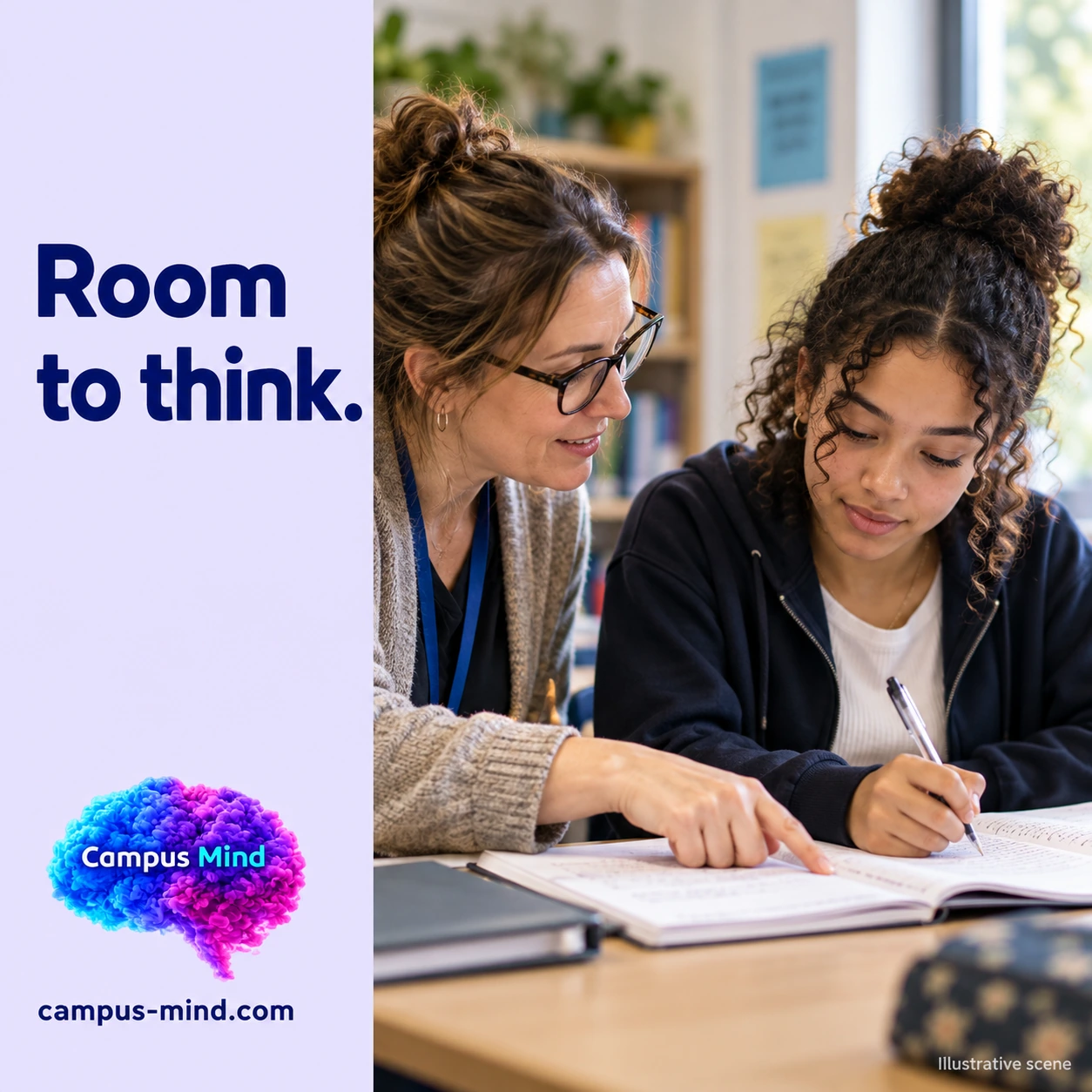
When a student asks for help, a teacher makes a small but important judgement: what should happen next?
Sometimes the student needs an explanation. Sometimes a question is enough. Sometimes they need help recognising which part of a problem they already understand. The aim is to help them move forward while keeping them involved in the thinking.
That judgement matters when bringing AI into learning. An impressive response on a screen is easy to notice. The more useful question is what the student can do after reading it.
What does scaffolding mean in practice?
Scaffolding gives a learner support for a task they cannot yet manage independently. That support should respond to their understanding and reduce as they become more capable. It might be a prompt, a worked example, a planning frame or a question that directs attention to an important detail.
The EEF's Metacognition and Self-Regulated Learning guidance recommends explicitly teaching, modelling and scaffolding strategies for planning, monitoring and evaluating learning. It also emphasises applying those strategies within subjects and specific tasks.
We use these principles to inform how we think about student guidance in Campus Mind. They give us a clear educational direction: guidance that helps students become more independent.
Start with the student's attempt
Before offering substantial help, ask what the student has tried and where they became unsure. This creates a starting point for guidance and gives the student an opportunity to explain their thinking.
A useful prompt might be: "Show me your first step and tell me which part you are least sure about." For an essay, that could mean sharing a proposed argument. For a calculation, it could mean identifying the quantities involved.
An attempt does not have to be correct to be useful. It gives the next question something specific to work with.
Match the help to the obstacle
A student who has forgotten a key concept needs different support from one who knows the concept but cannot apply it. Repeating the whole explanation may miss the difficulty.
In an illustrative maths task, a learner might be able to describe a method but select the wrong operation. A prompt asking why they chose that operation could reveal more than another completed solution. If the explanation shows a gap in understanding, a short model followed by a similar task may be appropriate.
The teacher's knowledge of the curriculum and learner remains important. AI guidance should be checked against what has been taught and the learning the task is intended to develop.
Give a useful hint, then return responsibility
A scaffold needs to help the learner act. "Think harder" offers little direction. A prompt such as "Which piece of evidence supports your first point?" is more concrete.
After the hint, give the student space to respond. Ask them to choose a next step, justify a decision or revise their attempt. This is where the interaction can become a learning conversation.
Schools can use these illustrative teaching examples when considering the behaviour they want from an educational AI tool.
Reduce support and check understanding
A successful interaction should create opportunities for greater independence. Once a learner can explain a step, the next task might need a shorter prompt or no prompt at all.
Useful checks include asking the student to explain the method in their own words, attempt a related question without help, or identify what they would do differently next time. Being able to repeat an AI response is different from being able to use the idea independently.
There is no single rule for when to remove support. Teachers make that decision using the student's work, discussion and response to new tasks.
How Campus Mind fits into the picture
Campus Mind's student guidance is shaped around helping young people THINK with AI. The intention is for questions, prompts and explanations to support the learner's next step, with educational choices and staff oversight built into the approach.
That requires ongoing attention. A response may give too much help, too little help or an explanation that needs correcting. Reviewing student AI interactions can help authorised staff explore these questions alongside classroom evidence.
Schools should define appropriate uses, explain expectations and retain the teacher's role in judging learning. The Department for Education's AI guidance emphasises professional judgement and notes that evidence about pupil-facing AI continues to develop.
The ambition is straightforward: more thoughtful guidance when a learner needs help, and more room for that learner to do the thinking.
Read our school implementation case study to see how Campus Mind has been introduced in practice, or explore Campus Mind to discuss how this approach could fit your school.