AI-supported revision: plan, practise and review
By Daniel Pearson, Education AI Consultant and Director of Campus Mind. Published 4 October 2026.
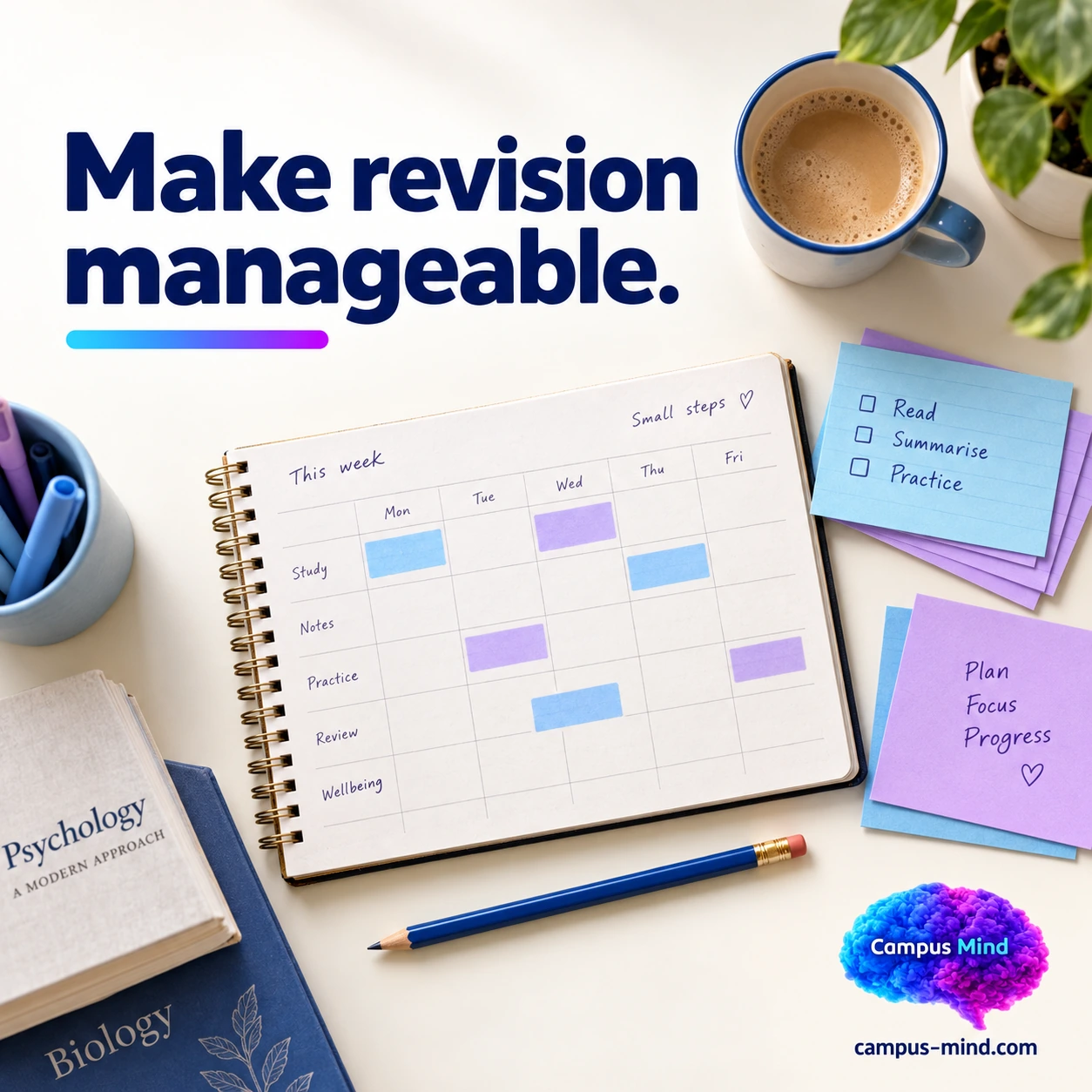
“Go and revise” sounds like a simple instruction. For a student, it can mean choosing a topic, judging what they know, deciding how to practise and working out whether the effort is helping. Those decisions deserve to be taught.
AI can create a timetable quickly. A more useful educational ambition is to help the student understand the decisions behind it. At Campus Mind, we want guided AI support to keep learners involved in choosing, attempting, checking and adapting their work.
The following routine is a practical starting point for teachers and schools. It can be modelled in class, used in a conversation with a student and supported through a school-approved AI tool. The suggested prompts can be adapted to the learner, the subject and the school's expectations.
1. Plan a specific piece of learning
Start with what the student needs to learn, using the teacher's topic list, lesson materials or revision guidance. “Revise biology” is hard to act on. A named concept, explanation or type of question gives the session a clearer purpose.
Useful prompts include:
- Which part of this topic feels least secure?
- What do you already understand about it?
- What has your teacher asked you to practise?
- What would a useful first attempt look like?
Ask the student to explain why they have chosen that task. A plan that reflects their understanding is more useful than one they accept without considering it. Teachers can model their own decisions aloud before asking students to make similar choices independently.
The EEF's updated metacognition guidance supports explicitly teaching, modelling and scaffolding planning, monitoring and evaluation within subject learning. Those principles provide a useful foundation for teaching students how to organise and judge their revision.
2. Practise before accepting an explanation
A revision session needs something the student actually does. That could be recalling key ideas without notes, attempting a teacher-selected question or explaining a process in their own words. The activity should fit the subject and the material already taught.
Possible prompts are:
- What can you explain from memory before checking your notes?
- Which step can you attempt on your own?
- Where does your explanation become uncertain?
The EEF's overview of retrieval practice explains why recalling previously learned material can support learning. This gives teachers a reason to include opportunities for students to try remembering, rather than relying entirely on rereading.
With AI, the sequence matters. If the student sees a complete answer first, it may be difficult to tell what they could produce independently. Guided support can instead invite an attempt, offer a focused prompt and ask the learner to explain their reasoning.
3. Check against a reliable reference
After the attempt, build in a check. Use approved lesson materials, a teacher's explanation or other resources the school has selected. AI-generated feedback also needs scrutiny: a convincing response can contain a mistake or miss the emphasis of the course.
Ask what the student got right, which part needs attention and how they know. A simple correction is more useful when the learner understands it and can try the relevant part again.
These conversations should make it comfortable to identify uncertainty. “I still cannot explain this step” gives a teacher something specific to work with. “The AI said it was good” gives much less information.
4. Review and choose what happens next
End by asking the student to account for the session. What can they now attempt that they could not do at the start? What remains unclear? What should they revisit, practise differently or take to their teacher?
The next decision should follow that reflection. It might be another question, a return to an explanation or a request for help. A timetable becomes useful when it changes in response to what the student discovers.
For a manageable session, a teacher might agree one topic, one independent attempt, one check and one next step. This is an example to adapt to the learner and the subject, rather than a fixed prescription.
Where Campus Mind fits
Campus Mind's guided approach aims to support this kind of active participation through questions, prompts and step-by-step guidance. The student remains responsible for the attempt and the reflection. Teachers shape the expectations and bring the subject knowledge needed to judge the work.
Our anonymous example of a student finding a place to begin shows why these starting decisions matter. The implementation case study explains how revision support sits within a school-controlled AI environment.
Explore Campus Mind to see how your school could bring guided AI into teaching and learning. For more practical perspectives, visit our Insights hub.